



CONCERNED About A.I.? Use It for Good!
[Commentary]
ARTIFICIAL intelligence (or A.I.) is no longer a distant concept. It is woven into daily life through tools like ChatGPT, Gemini, Claude, and Grok. These systems draw from vast collections of human knowledge and are designed to respond to nearly any question.
Yet with this breadth comes a serious responsibility. They can sound persuasive even when incorrect, and they can reflect human bias, speculation, or even theological error if used carelessly.
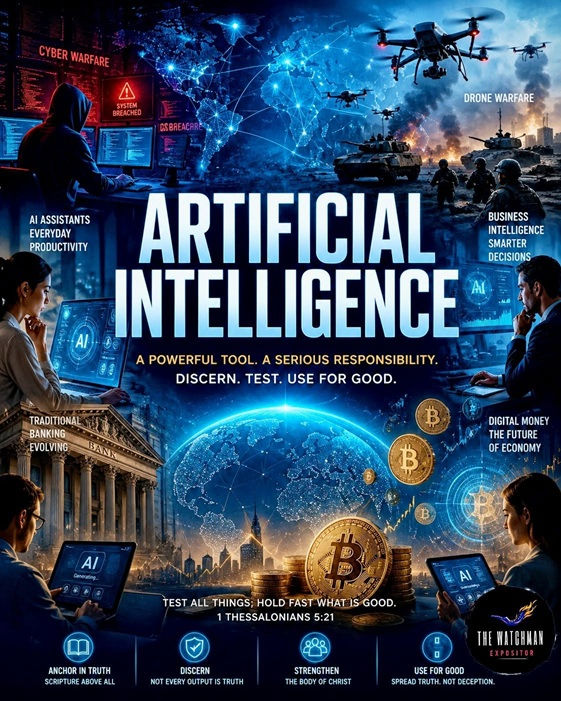
Because of this, definitions matter. Not all AI is the same. There is a clear difference between broad, open systems built for mass influence and narrower tools used with intention and boundaries. Scripture reminds us that wisdom begins with discernment. “Test all things; hold fast what is good” (1 Thessalonians 5:21).
The issue is not merely the technology itself but how it is used and the spirit behind its use.
There are valid concerns. The rapid development of AI, robotics, and digital systems points toward increasing centralization of power. Revelation 13 describes a system capable of controlling buying and selling. For the first time in history, humanity is developing tools that could realistically support such global oversight.
While we cannot declare with certainty that current systems fulfill this prophecy, the trajectory is difficult to ignore.
Yet fear is not the response God calls His people to. “God has not given us a spirit of fear, but of power and of love and of a sound mind” (2 Timothy 1:7). Panic leads to poor judgment. Discernment leads to faithful action.
Throughout Scripture, tools themselves are neutral, but their use reveals the heart. Fire can destroy a city or warm a home. The same principle applies here. AI can be used to spread confusion, false doctrine, and manipulation. It can also be used to organize study, clarify language, and help people engage more deeply with the Word of God.
The adversary thrives on deception. Jesus warned that falsehood would increase, even deceiving many (Matthew 24:24). It is not unreasonable to expect AI to become a powerful instrument in that deception. But that does not mean believers should abandon the field entirely.
Truth must still be proclaimed. Light must still shine in darkness.
Paul’s instruction is relevant here. “Do not be overcome by evil, but overcome evil with good” (Romans 12:21). If a tool can be used to mislead, it can also be used to teach rightly when anchored in Scripture. The responsibility lies with the user to remain grounded in God’s Word, not in the outputs of a machine.
God remains sovereign over history. No technological advance escapes His awareness or authority. “The Most High rules in the kingdom of men” (Daniel 4:17). That truth provides stability in a rapidly changing world.
The goal, then, is not blind acceptance or total rejection. It is careful, sober use. Use AI as a servant, not a master. Let Scripture remain the final authority. Measure every insight against the Word. When used this way, even a powerful and imperfect tool can serve a higher purpose.
The question is not simply whether AI is dangerous. The deeper question is whether God’s people will use what is available to uphold truth, strengthen faith, and point others back to Him.
Rh.


Comments