



JUDAISM is Not the Religion of Moses
Updated: Jul 21
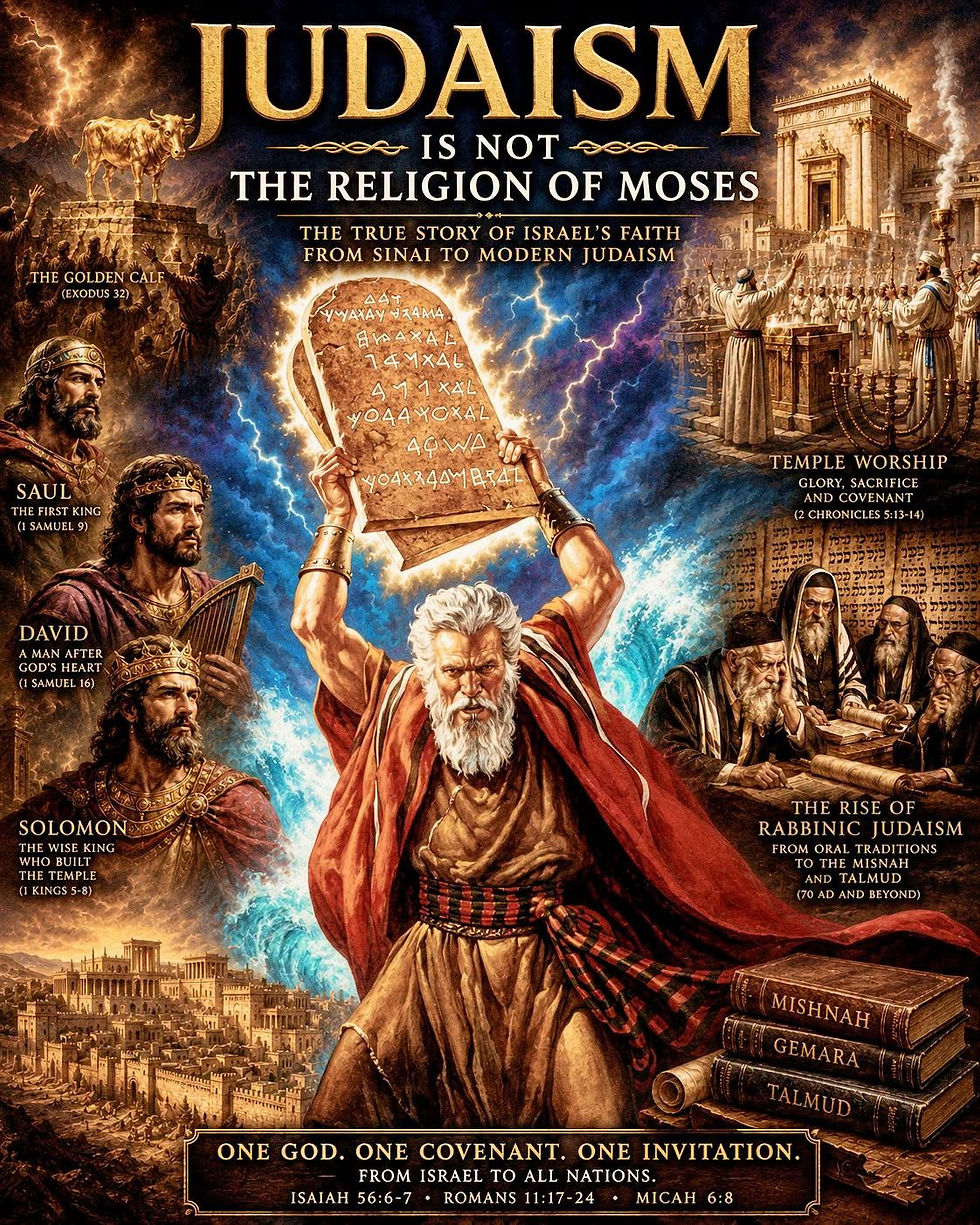
ONE of the most widespread assumptions in modern Christianity is that the faith practiced by Moses, Joshua, David, Isaiah, and the prophets was simply Judaism. Consequently, whenever believers encounter people observing the Sabbath, studying the Torah, keeping biblical dietary laws, or celebrating the festivals listed in Leviticus 23, they often conclude, “Those practices are Jewish.”
Yet history and Scripture reveal a more nuanced picture. While Judaism and the faith of ancient Israel are closely related, they are not identical. Understanding this distinction helps us read the Bible more accurately and appreciate the unfolding story of God's covenant.
THE COVENANT AT SINAI Was Given to Israel
When God established His covenant at Mount Sinai, He was not addressing a people called “Jews.” He was speaking to the nation of Israel—the descendants of the twelve sons of Jacob.
Exodus describes not only the Israelites leaving Egypt but also a “mixed multitude” who departed with them (Exodus 12:38). These non-Israelites witnessed God's deliverance and attached themselves to Israel's God. They stood under the same covenant obligations and blessings.
Scholar Christopher J. H. Wright observes that Israel's covenant identity was never merely ethnic but fundamentally covenantal—defined by relationship with God and obedience to His commands.
The Torah (also called 'The Five Books of Moses') repeatedly emphasizes this principle:
"One law shall be to him that is homeborn, and to the stranger that sojourns among you." (Exodus 12:49, KJV)
"You shall have the same standard for the stranger as for the native-born; for I am the LORD your God." (Leviticus 24:22, NASB)
“One law and one rule shall be for you and for the stranger who sojourns with you” (Numbers 15:16).
From the beginning, God's instruction was directed to a covenant community rather than to a single tribe or ethnic category.
THE ORIGIN OF THE Term “Jew”
The word “Jew” derives from Judah, one of Jacob's twelve sons.
Following Solomon's reign, the united kingdom divided. The northern tribes retained the name Israel, while the southern kingdom became known as Judah (1 Kings 12). Over time, inhabitants of this southern kingdom became known as Judahites, later shortened to “Jews.”
The term became increasingly common during and after the Babylonian exile.
This means Moses was not a Jew in the later historical sense. Neither were Abraham, Isaac, Jacob, nor most of Israel's early leaders. The Torah existed centuries before the emergence of Judaism as a distinct religious identity.
As historian E. P. Sanders notes, Second Temple Judaism developed from Israel's earlier covenant traditions but represented a later historical phase in Israel's religious life.
GOD'S COVENANT WAS NEVER Exclusively Ethnicity
A common misconception is that God's covenant concerned only biological descendants of Israel.
Scripture consistently presents a broader vision.
Rahab, a Canaanite, joined God's people (Joshua 6:25). Ruth, a Moabite, famously declared:
“Your people shall be my people, and your God my God” (Ruth 1:16).
Isaiah even foresaw foreigners joining themselves to the Lord and keeping His covenant (Isaiah 56:6–7).
This principle continues into the New Testament. Paul describes Gentile believers as branches grafted into the olive tree of Israel (Romans 11:17–24). He was not introducing a new idea but explaining a pattern visible throughout Scripture.
The covenant was entrusted to Israel, but God's invitation extended far beyond Israel's borders.
WHAT THEN IS 'Judaism'?
Judaism emerged from Israel's history but should not be confused with the entire biblical faith of Moses.
The Hebrew Scriptures form Judaism's foundation, yet Judaism also includes centuries of interpretation, tradition, and rabbinic authority developed after the biblical period.
During the Second Temple era, groups such as the Pharisees emphasized both the written Torah and oral traditions. According to the Jewish scholar Jacob Neusner, these traditions eventually became the foundation of Rabbinic Judaism.
This historical context sheds light on many of Jesus' confrontations with religious leaders. His criticism was not directed against Moses or God's law but against traditions that, in some cases, obscured God's commandments (Mark 7:6–13).
THE RISE OF RABBINIC Judaism
The destruction of Jerusalem and the Temple in AD 70 transformed Jewish religious life.
Without the Temple, sacrifices ceased, and priestly functions could no longer operate as prescribed in the Torah. Leadership increasingly shifted to rabbis, who preserved and systematized oral traditions.
These traditions were eventually compiled into the Mishnah and later expanded in the Talmud. From this process emerged Rabbinic Judaism—the form of Judaism that largely continues today.
The respected historian Shaye J. D. Cohen notes that modern Judaism is not simply ancient Israelite religion preserved unchanged; rather, it is a post-Temple development that adapted Israel's heritage to new historical realities.
WHY DISTINCTION Matters
Recognizing this distinction is not an attack on Jewish people. It is a matter of historical and biblical accuracy.
The religion of Moses was not called Judaism. It was the covenant faith of Israel—a faith centered on worshiping the God of Abraham, Isaac, and Jacob, obeying His commandments, and walking humbly before Him.
Judaism emerged later as a historical descendant of that faith, preserving many biblical practices while also developing additional traditions and interpretations.
Therefore, practices such as the Sabbath, biblical festivals, and clean foods should not automatically be dismissed as merely “Jewish.” They existed long before Rabbinic Judaism and were embedded within the covenant God established with Israel.
Whether Christians believe such practices remain binding today is a separate theological discussion. But historically, the faith revealed through Moses was not Judaism in its later rabbinic form.
It was the covenant way of life God gave to Israel and to all who chose to join themselves to Him.
As Ecclesiastes concludes:
"Let us hear the conclusion of the whole matter: Fear God and keep His commandments, For this is man’s all. For God will bring every work into judgment, including every secret thing, whether good or evil.” (Ecclesiastes 12:13-14).
Not merely the duty of one tribe, one nation, or one ethnicity—but a calling addressed to all humanity.
And as the prophet Micah reminds us:
“What does the LORD require of you but to do justice, to love mercy, and to walk humbly with your God?” (Micah 6:8).
That timeless call transcends every label and points us back to the heart of biblical faith itself.


Comments