



Law of MOSES Vs. Law of CHRIST: Did the Law of Christ Supersede the Law of Moses?

"If you believed Moses, you would believe me...But if you do not believe his writings, how will you believe my words?" -- Jesus in John 5:46-47
MANY Christians assume that the “Law of Christ” replaced the “Law of Moses,” as though God abandoned one system and created another. Yet Scripture presents a far deeper and more consistent picture. The Bible reveals one righteous God, one holy standard, and one divine purpose unfolding from Genesis to Revelation.
Were Moses and Jesus on opposite sides of God's law? Yet Jesus says we need to believe Moses before we can believe Him!
THE LAW OF MOSES VIS-À-VIS THE COMMANDMENTS OF GOD
So what exactly is the Law of Moses? Did God give Moses a completely different law from His own eternal righteousness?
The Bible repeatedly calls the commandments “the Law of God” (Nehemiah 8:8; Psalm 19:7). Moses was not the originator of the law; he was the mediator through whom God delivered His commandments to Israel. Israel was chosen to become “a holy nation” and “a kingdom of priests” (Exodus 19:5–6). Through obedience to God’s laws, they were to reflect His righteousness before the nations.
Moses himself declared: “The LORD commanded me at that time to teach you statutes and judgments” (Deuteronomy 4:14). The source was always God. His law reflected His character—holy, just, and good (Romans 7:12).
The “Law of Moses” included civil regulations, sacrificial rituals, priestly ordinances, and moral commandments. Some aspects pointed forward to Christ’s sacrifice and priesthood. Hebrews explains that sacrifices and temple rituals were “a shadow of good things to come” (Hebrews 10:1). But the moral foundation of God’s law was never described as sinful or abolished.
JESUS MAGNIFIED THE LAW
What then is the “Law of Christ”?
The expression appears directly only twice in the New Testament. Paul wrote, “Bear one another’s burdens, and so fulfill the law of Christ” (Galatians 6:2). He also said he was “under the law toward Christ” (1 Corinthians 9:21).
Many theologians historically interpreted this phrase as an entirely new ethic replacing Moses. However, modern scholarship increasingly challenges that assumption. Scholar Todd Wilson notes a “growing scholarly consensus” that the “law of Christ” should be understood in continuity with the Mosaic law as interpreted and embodied by Jesus Himself.
Jesus never taught rebellion against God’s commandments. Instead, He magnified them. In the Sermon on the Mount, Christ moved beyond mere outward compliance and exposed the spiritual intent of the law. Murder begins with hatred; adultery begins with lust (Matthew 5:21–28). Rather than lowering the standard, Christ deepened it.
JESUS AND PAUL UPHOLD THE LAW
Jesus plainly declared: “Do not think that I came to destroy the Law or the Prophets” (Matthew 5:17). The Greek term for “destroy” means to abolish or tear down. Christ instead fulfilled the law perfectly and revealed its fullest meaning.
The Law of Christ, therefore, is not a cancellation of God’s law but the law as taught, lived, and exemplified by Christ. It is God’s commandments written upon the heart through the Holy Spirit (Jeremiah 31:33). Love becomes the motive for obedience, not a replacement for it.
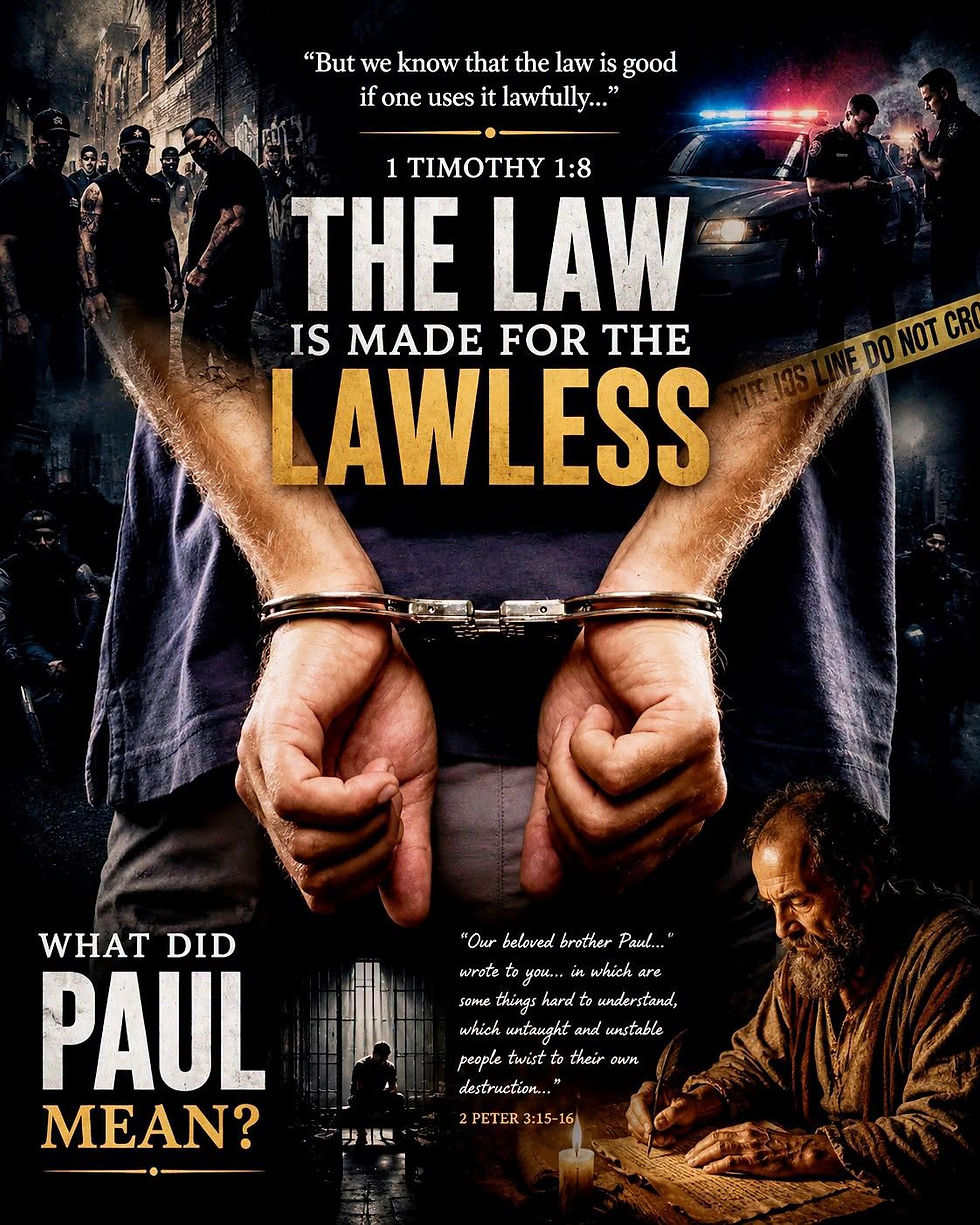
Paul’s writings are often misunderstood on this issue. The apostle opposed justification by “works of law” as a means of earning salvation, yet he repeatedly upheld obedience. He wrote, “Circumcision is nothing and uncircumcision is nothing, but keeping the commandments of God is what matters” (1 Corinthians 7:19).
Likewise, Romans 3:31 asks: “Do we then make void the law through faith? Certainly not! On the contrary, we establish the law.”
GOD'S GRACE EMPOWERS OBEDIENCE
Even the final book of the Bible connects God’s end-time people with obedience. Revelation describes the saints as “those who keep the commandments of God and the faith of Jesus” (Revelation 14:12). Here, faith in Christ and obedience to God stand together—not in opposition.
The Law of Christ is therefore not a rival law competing against Moses. It is the fulfillment, explanation, and spiritual application of God’s eternal righteousness through Jesus Christ. The same God who spoke at Sinai also spoke through His Son. His standards did not become evil after the cross. Instead, Christ enables believers to walk in the spirit and intent of God’s holy law.
Grace does not abolish obedience. Grace empowers it!


Comments