



"THE LAW IS MADE FOR THE LAWLESS": What Did Paul Really Mean?
Updated: Jul 22
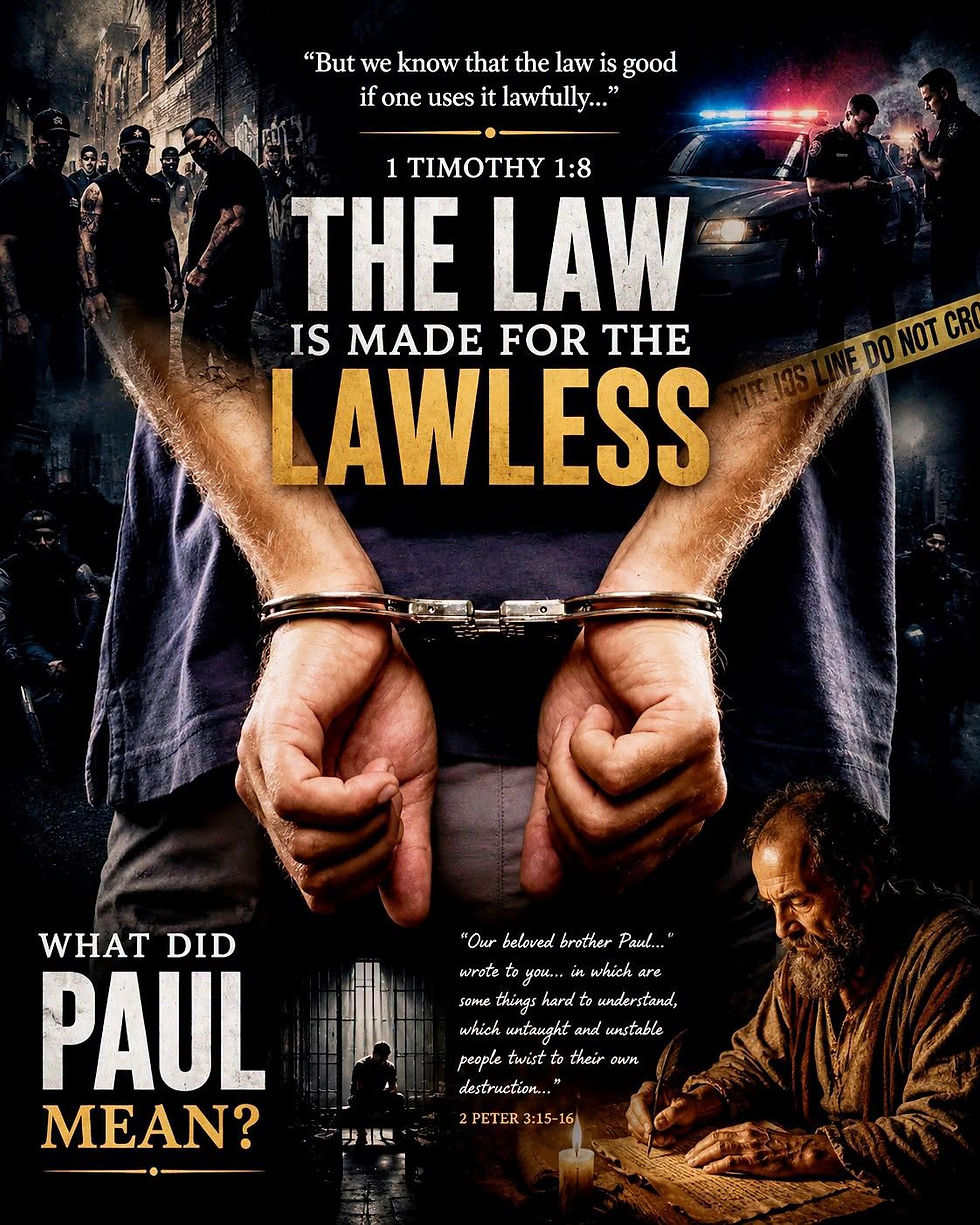
DID the apostle Paul teach that God's law applies only to criminals and sinners? Did he mean that once a person considers himself "righteous," God's commandments are no longer necessary?
These questions often arise from a misunderstanding of 1 Timothy 1:8–9:
"But we know that the law is good if one uses it lawfully, knowing this: that the law is not made for a righteous person, but for the lawless and insubordinate, for the ungodly, for sinners, for the unholy and profane, for those who kill their fathers or mothers, for murderers..." (1 Timothy 1:8–9).
Far from diminishing God's law, Paul begins with an important declaration: "The law is good if one uses it lawfully." The problem, therefore, is never with the law itself but with those who misuse, misinterpret, or reject it.
THE LAW AS 'MIRROR'
Paul's point is straightforward. Civil laws exist because crime exists. Likewise, God's moral law exposes sin because humanity has sinned. As the apostle elsewhere wrote, "Through the law comes the knowledge of sin" (Romans 3:20), and "I would not have known sin except through the law" (Romans 7:7). The law functions like a mirror—it does not create dirt on the face but reveals what is already there.
When Paul says that "the law is not made for a righteous person," he is not suggesting that righteous people are exempt from obedience. Rather, those who genuinely walk with God have God's law written on their hearts (Jeremiah 31:33; Hebrews 8:10). They do not obey merely because they fear punishment but because they love God. Jesus Himself declared, "If you love Me, keep My commandments" (John 14:15).
Obedience is the fruit of a transformed heart, not a substitute for grace.
THE RIGHTEOUS ARE NOT FREE TO DISREGARD GOD'S LAW
The Jamieson-Fausset-Brown Commentary explains that the law "is not aimed at one who fulfills it, but at those who violate it." Likewise, the Matthew Henry Commentary observes that the law is designed to restrain wickedness and convict sinners, not to burden those who already delight in doing God's will. Neither commentary concludes that the righteous are free to disregard God's commandments.
Paul then lists behaviors that directly violate the Ten Commandments—rebellion, irreverence, murder, sexual immorality, kidnapping, lying, and perjury (1 Timothy 1:9–10). This is no coincidence. His list reflects the continuing moral standard revealed by God. The law identifies sin by defining what sin is.
LAWLESSNESS LEADS TO WICKEDNESS
The Greek word often translated "lawlessness" is 'anomia', meaning "without law" or "violation of the law." The apostle John gives the Bible's own definition: "Sin is lawlessness" (1 John 3:4, NKJV). Sin is not merely an unfortunate mistake; it is transgression against God's righteous standard.
Another related Greek term is 'athesmos', translated "wicked" or "lawless." Strong's Concordance defines it as one who disregards what has been established by God. Such lawlessness is not accidental ignorance but a willful rejection of divine authority.
This explains why Peter issued a solemn warning concerning Paul's writings:
"Our beloved brother Paul... wrote to you... in which are some things hard to understand, which untaught and unstable people twist to their own destruction, as they do also the rest of the Scriptures... beware lest you also fall from your own steadfastness, being led away with the error of the wicked ('athesmos')." (2 Peter 3:15–17)
DISTORTING PAUL'S WRITINGS
Peter anticipated that some would distort Paul's letters to promote lawlessness. Tragically, that warning remains relevant today. Whenever Paul's teaching is used to argue that God's commandments have been abolished or no longer matter, his words are being pressed into service for the very error Peter condemned.
Paul consistently upheld the goodness of God's law. He declared, "Therefore the law is holy, and the commandment holy and just and good" (Romans 7:12). He even asked, "Do we then make void the law through faith? Certainly not! On the contrary, we establish the law" (Romans 3:31).
The gospel does not abolish God's standard—it empowers believers to live according to it through the Holy Spirit (Romans 8:3–4). Grace is never permission to continue in sin; it is God's power to overcome it (Titus 2:11–14).
THE LAW AS WITNESS AND GUIDE FOR HOLY LIVING
The message of 1 Timothy 1 is therefore unmistakable. The law stands as God's witness against sin and as a guide for holy living. The lawless fear it because it exposes their rebellion. The righteous cherish it because it reflects the character of the Lawgiver.
As the psalmist joyfully confessed:
"Oh, how I love Your law! It is my meditation all the day." (Psalm 119:97)
Those who truly belong to Christ do not seek freedom from God's law—they seek freedom from sin, so they may delight in walking in His commandments.


Comments