



Why Does God Allow SUFFERING?

LOOK at our world and the question becomes unavoidable. Wars rage, natural disasters, civilians flee their homes, famine stalks vulnerable populations, diseases continue to threaten millions, corruption enriches the powerful while the poor struggle, and violence leaves families shattered. From Ukraine and Gaza to Sudan and other forgotten conflicts, the headlines repeatedly expose humanity's inability to create lasting peace.
History gives the same sobering testimony. Two world wars, the Holocaust, genocides, famines, pandemics and countless civil conflicts reveal a recurring pattern: human beings possess extraordinary power, but without righteous character, that power can become destructive.
So the ancient question remains: 'If God is loving and all-powerful, why does He permit suffering?'
The Bible does not answer by pretending suffering is insignificant. It begins with a startling truth: God created humanity with genuine moral responsibility. “I have set before you life and death, blessing and cursing: therefore choose life” (Deuteronomy 30:19).
God could compel obedience. But compelled obedience is not the same as righteous character.
Humanity's fundamental problem is that we have repeatedly chosen our own way. Isaiah declared, “All we like sheep have gone astray; we have turned every one to his own way” (Isaiah 53:6). Scripture contrasts human thinking with God's: “My thoughts are not your thoughts, neither are your ways my ways” (Isaiah 55:8).
The result is written across history.
THE EXPERIMENT OF HUMAN RULE
The biblical story of Eden presents humanity's defining choice. Satan challenged God's authority and persuaded humanity that independence from God would bring greater freedom and knowledge (Genesis 3:1–6).
That deception established the recurring human philosophy: “my will, my desires, my advantage.”
Cain's murder of Abel quickly demonstrated where unchecked human hostility could lead (Genesis 4:8). Centuries later, Jesus summarized the opposite way of life: “It is more blessed to give than to receive” (Acts 20:35).
God's law is fundamentally relational—love toward God and love toward neighbor (Matthew 22:37–40). Yet civilization has repeatedly been built around power, possession, rivalry, domination and self-interest.
The twentieth century provided perhaps the most devastating demonstration. The Holocaust showed what can happen when racism, propaganda, authoritarian power and dehumanization combine. Six million Jews were murdered because an entire ideological system declared them less than human.
The lesson is terrifying: when human beings reject the Creator's moral boundaries, freedom can become a weapon against the innocent.
WHY DOESN'T GOD SIMPLY STOP IT?
Because God's purpose is larger than merely preventing every painful consequence immediately.
God is developing people who willingly choose righteousness. Character cannot simply be programmed into a person. It must be chosen, tested and developed.
Even Christ “learned... obedience by the things which he suffered” (Hebrews 5:8). His suffering was not evidence of God's abandonment; it became part of His redemptive mission.
The apostle Paul likewise wrote that “the whole creation groaneth and travaileth in pain together until now” (Romans 8:22). Yet he immediately points beyond present suffering to future glory.
This does not mean God approves of suffering. Scripture repeatedly commands His people to defend the vulnerable, feed the hungry, care for strangers and pursue justice.
Nor does every individual tragedy represent a specific punishment from God. Jesus rejected that simplistic assumption (John 9:1–3; Luke 13:1–5).
THE BIBLE PROMISES AN END
The Christian hope is not that humanity will eventually perfect itself.
It is that God will intervene.
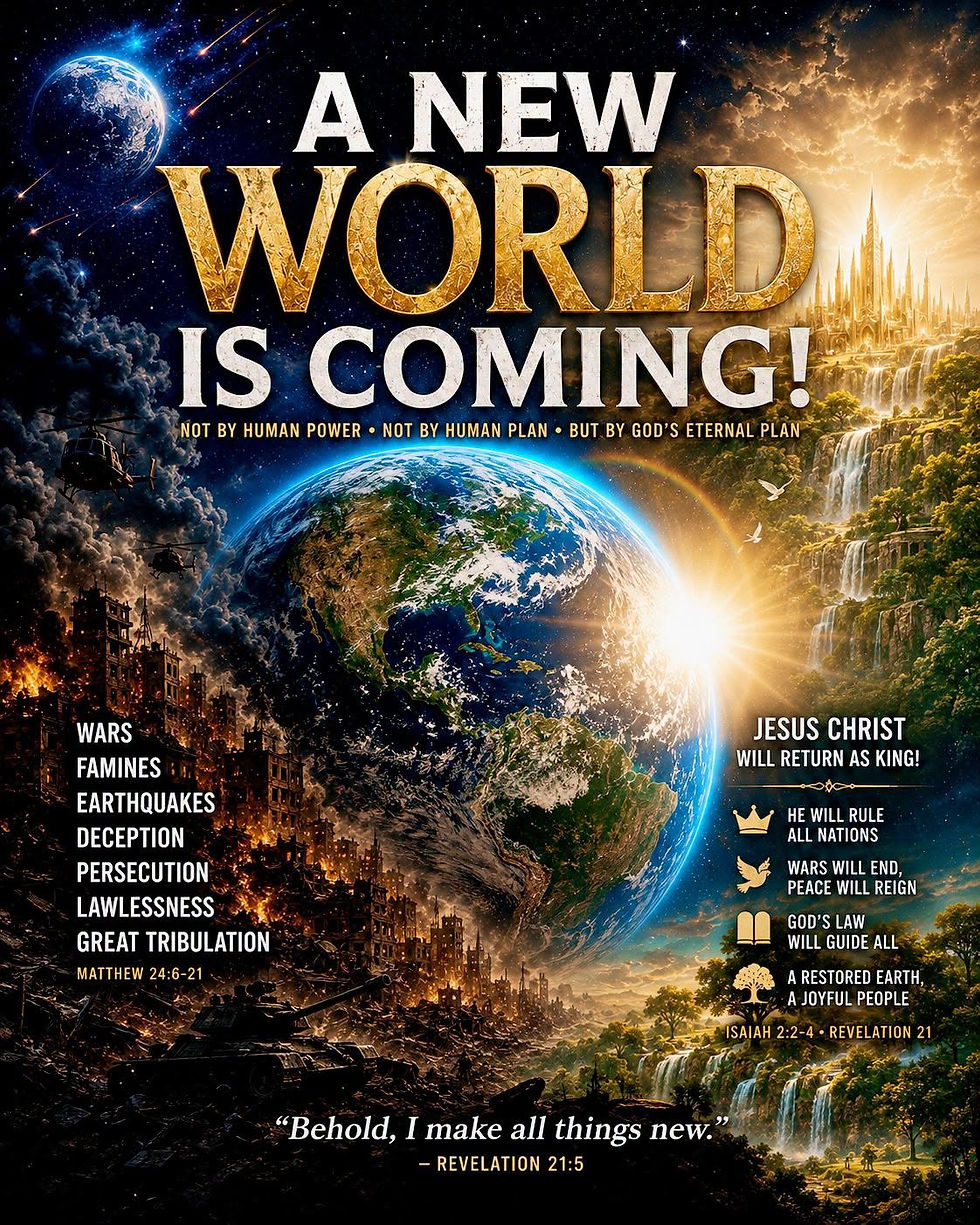
Jesus proclaimed the coming Kingdom of God (Mark 1:14–15). Scripture foresees a time when nations will “beat their swords into plowshares” and “nation shall not lift up sword against nation” (Isaiah 2:4).
Revelation presents the final horizon:
“God shall wipe away all tears from their eyes; and there shall be no more death, neither sorrow, nor crying” (Revelation 21:4).
The prophetic message is therefore both warning and hope.
Human history is demonstrating what happens when humanity insists on governing without God. But history will not have the final word.
The Bible declares that Christ will return, Satan will ultimately be defeated, and God's righteous government will replace the broken systems of this age (Revelation 19:11–16; 20:1–6).
The darkness is real—but it is not permanent.
Suffering is not God's final answer. Redemption is.
And the day is coming when humanity will finally understand the wisdom of God's way—not merely because God commands it, but because history itself will have demonstrated the devastating consequences of every alternative.
“Behold, I make all things new” (Revelation 21:5).
That is the prophetic hope beyond the world's suffering!


Comments